TL;DR
Real estate agents should treat SEO as a local lead system, not a one-time website task. The highest-return plan combines neighborhood pages, useful property content, Google Business Profile work, reviews, and local links. Agents with limited time should start with one target area, publish one strong page, and build proof around it.
Google often becomes the first showing appointment before a buyer or seller ever contacts an agent. SEO for real estate agents helps local professionals appear when people search for neighborhoods, home values, open houses, and listing help. For teams that want a cleaner workflow, Earlyseo can help organize SEO tasks, publishing, and optimization without turning the process into a full-time job.
Table of Contents
What is SEO for real estate agents?
SEO for real estate agents is the process of improving an agent or brokerage website so it can earn organic visibility for local property, neighborhood, and client-intent searches. The goal is simple: turn Google searches into qualified buyer, seller, landlord, or renter leads through useful pages, strong local signals, and trustworthy content.
Real estate agent: A licensed professional who represents buyers or sellers of real property, usually under a licensed broker.
Real estate: Land, buildings, natural resources, and the legal interests connected to that property.
Real estate trend: A consistent pattern or change in the property market that becomes noticeable over time.
Key insight: Real estate SEO works best when each page answers a real local question, not when a site repeats generic city keywords across thin pages.
Search behavior is changing fast. AI search features, map packs, local listings, and traditional organic results now sit together. Research such as the 2023 ACL paper Self-Instruct: Aligning Language Models with Self-Generated Instructions shows how language models are trained to follow structured instructions, which is one reason clean definitions, tables, and checklists matter for answer engines.
Agents should think of SEO as owned visibility. Paid ads stop when budgets pause. Referrals slow down when networks go quiet. A useful neighborhood guide, market page, or seller resource can keep attracting searches long after publication.
Which SEO tasks matter most for local real estate leads?
The most important SEO tasks for local real estate leads are neighborhood pages, property-focused content, Google Business Profile optimization, review growth, technical health, and local authority building. These tasks work together because buyers and sellers compare agents across search results, maps, websites, and reviews before making contact.
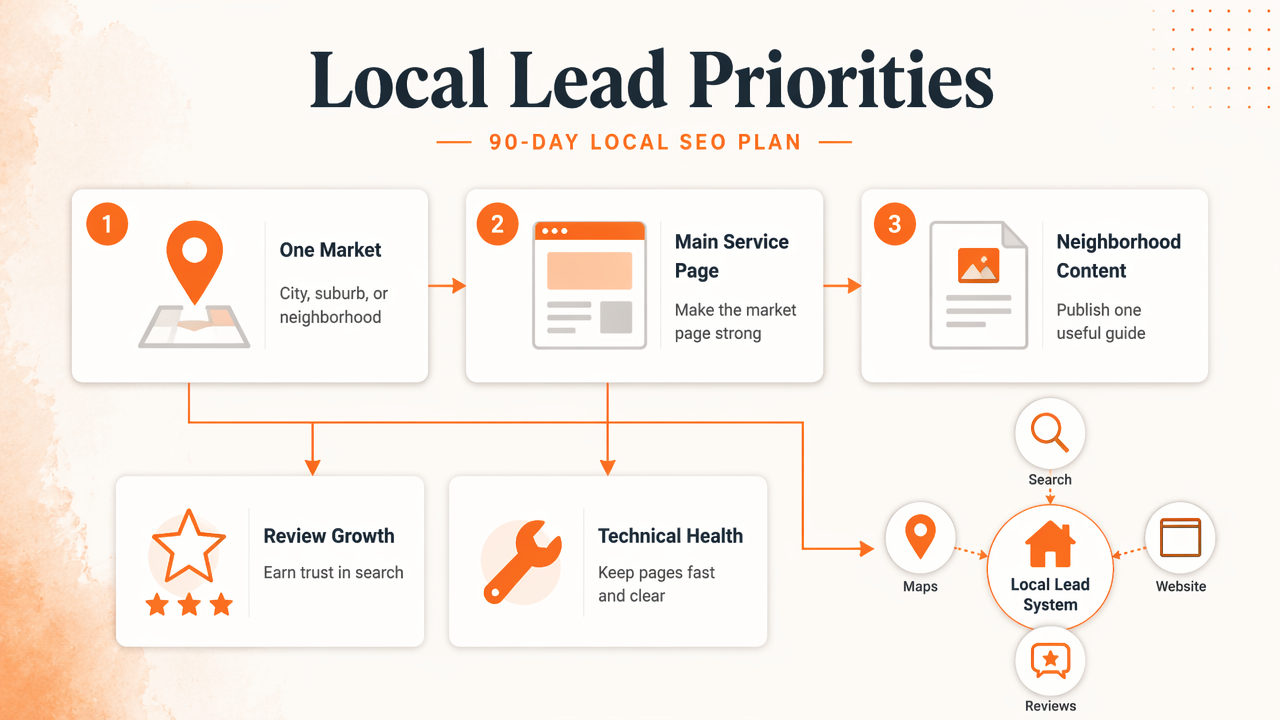
Priority checklist for a 90-day real estate SEO plan
A 90-day plan keeps the work focused and stops agents from chasing every keyword at once.
- Pick one primary market, such as a city, suburb, or neighborhood.
- Build or improve the main service page for that market.
- Publish one detailed neighborhood guide with schools, commute notes, housing styles, and local amenities.
- Update the Google Business Profile with services, photos, categories, and fresh posts.
- Request reviews from recent clients using a repeatable follow-up process.
- Add internal links from blog posts, listing pages, and agent bio pages.
- Check indexing, page speed, mobile layout, and contact forms monthly.
A tool-assisted workflow can reduce the busywork. The Earlyseo platform fits teams that want content planning, optimization, and publishing support in one place. For implementation details, the Earlyseo documentation is a useful next stop after the strategy is set.
Local SEO priorities by business goal
| Goal | Best SEO asset | Why it works |
|---|---|---|
| Buyer leads | Neighborhood guide | Matches searches about lifestyle, prices, and amenities |
| Seller leads | Home valuation page | Captures high-intent searches before listing decisions |
| Luxury listings | Area and property-type pages | Builds topical depth around premium searches |
| Relocation clients | Moving guide | Answers practical questions before an agent is chosen |
| Local map visibility | Google Business Profile | Supports calls, directions, reviews, and local discovery |
Each asset should have one clear job. A buyer guide should not become a seller pitch halfway through. A home valuation page should explain process, pricing factors, and next steps without burying the contact option.
Agents using WordPress can connect SEO work to publishing through the Earlyseo WordPress integration, which is helpful when neighborhood content and listing updates need a steady cadence.
How should agents build neighborhood and property content?
Agents should build neighborhood and property content around specific local intent, including where people want to live, what homes cost, what daily life feels like, and what buyers or sellers should know before acting. The strongest pages combine market knowledge, original local detail, and clear next steps.
Neighborhood page structure that earns trust
A strong neighborhood page should feel like local advice, not a copied directory entry. It can include:
- A short overview of the neighborhood and who it tends to fit
- Common home styles, lot sizes, and property types
- Notable streets, parks, schools, transit, and commute patterns
- Buyer concerns, such as parking, HOA rules, or inventory limits
- Seller concerns, such as seasonality and pricing strategy
- Internal links to nearby neighborhoods and related services
Local specificity matters because search engines and AI systems need clear entity signals. Names of communities, landmarks, schools, parks, and property types help connect a page to real-world demand.
A practical example: a page about condos in a downtown district should mention building types, parking norms, HOA considerations, walkability, and nearby business areas. A rural acreage page should cover zoning, wells, septic systems, road access, and land-use questions.
Property content should answer more than listing facts
Property pages and listing articles often fail because they repeat bedroom count, square footage, and price without adding context. Searchers already see basic listing data on portals. Agent-owned content should explain what the numbers mean.
Useful property content can cover:
- Why a layout works for certain households
- How the location affects commute or lifestyle
- What recent local activity suggests about demand
- Which repairs, upgrades, or disclosures deserve attention
- How the property compares with nearby alternatives
Strong real estate content does not compete with portals on inventory size. It competes on interpretation, local judgment, and trust.
For teams building repeatable briefs, Earlyseo integrations can support a smoother publishing setup across existing site systems. More examples and publishing ideas are available on the Earlyseo blog.
How do Google Business Profile, reviews, and local authority connect?
Google Business Profile, reviews, and local authority connect by proving that an agent is active, trusted, and relevant in a specific market. A website can explain expertise, but local search signals help validate that expertise across Google Maps, branded searches, and nearby service queries.
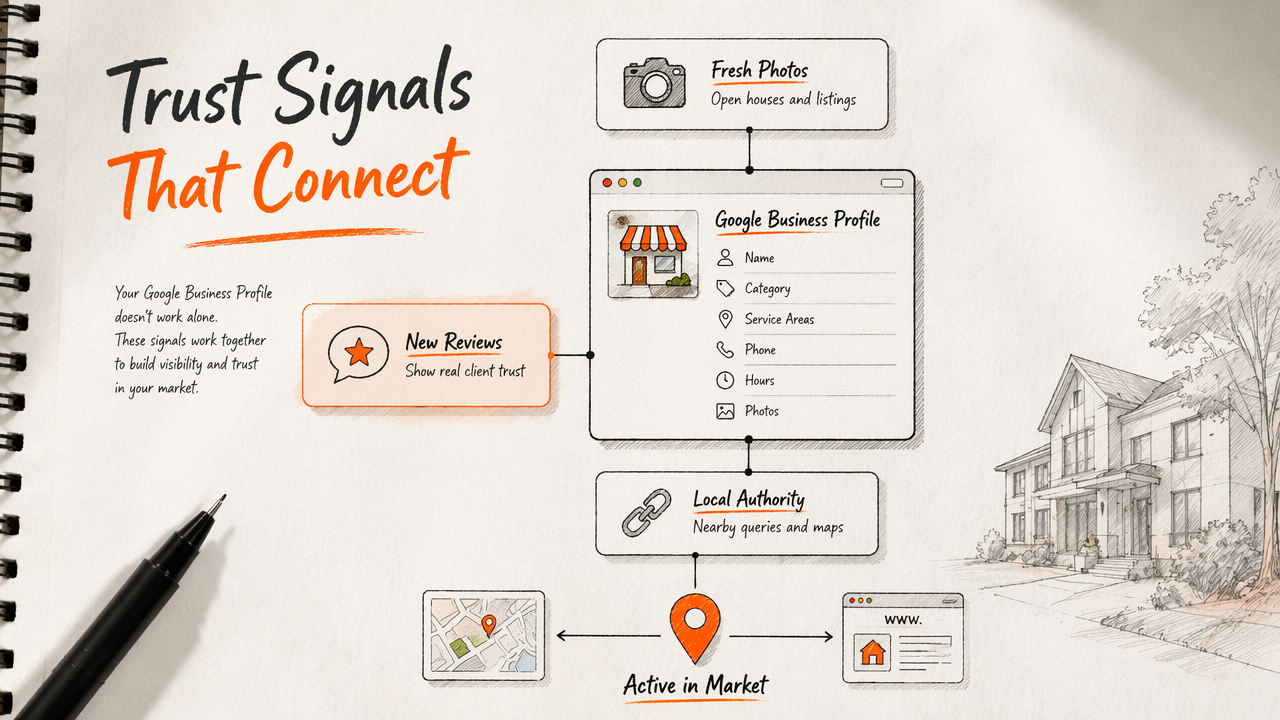
Google Business Profile basics for agents
A real estate Google Business Profile should be complete, accurate, and active. The profile should use the correct business name, category, service areas, phone number, website link, hours, photos, and business description.
The profile should also reflect real activity. Fresh photos from open houses, local events, office updates, and community work show that the business is alive. Posts can highlight market updates, buyer guides, seller resources, or new educational content.
Consistency matters. The agent name, brokerage relationship, phone number, and address details should match across major directories, brokerage pages, social profiles, and the agent website where applicable.
Review strategy without awkward pressure
Reviews work best when the request is timely and specific. A client who just closed, accepted an offer, or finished a consultation understands the value of the work while the experience is still fresh.
A simple review process can include:
- Send the request within a few days of a successful milestone.
- Explain that honest feedback helps local clients compare options.
- Provide the direct review link.
- Reply to every review with a calm, specific response.
- Save common client language for future FAQ ideas.
Local authority also comes from community proof. Sponsoring a school event, joining a chamber of commerce, contributing to a local housing report, or being listed on reputable local sites can create signals that support search visibility and brand trust.
What should real estate SEO look like in 2026 and 2027?
Real estate SEO in 2026 and 2027 should be structured for both search engines and AI answer systems, with clear entities, helpful local expertise, clean technical setup, and pages that can be summarized accurately. Thin keyword pages will keep losing ground to useful local resources.
AI-readable structure for real estate pages
AI search tools reward content that is easy to parse. That means short answers near headings, tables for comparisons, and clear definitions for important terms. Agents should avoid burying the useful answer after several promotional paragraphs.
Good structure includes:
- One clear topic per page
- Descriptive H2 and H3 headings
- Tables for neighborhood comparisons
- FAQ blocks for buyer and seller questions
- Schema markup where appropriate
- Internal links that explain topical relationships
Agents also need to control how AI systems understand site content. The Earlyseo llms.txt resource is relevant for teams thinking beyond classic search snippets and into AI citation readiness.
Technical basics that still matter
Technical SEO is not glamorous, but broken basics waste good content. Real estate sites often carry heavy images, IDX scripts, old listing URLs, duplicate pages, and slow mobile templates.
A practical audit should check:
- Mobile usability on listing and contact pages
- Image compression for listing galleries
- Indexing status for important market pages
- Redirects for expired property URLs
- Clear navigation to neighborhoods, services, and contact forms
- Form tracking for calls, valuations, and showing requests
Earlyseo can help organize optimization work so agents spend less time guessing what to fix next. For a direct look at the platform, visit earlyseo.com.
FAQ about real estate SEO
Real estate SEO questions usually come down to scope, timing, content choices, and whether local search can compete with large portals. The short answer: agents do not need to outrank every portal everywhere, but they do need to own specific local topics better than generic sites.
How long does real estate SEO take?
Real estate SEO usually takes several months to show meaningful traction because Google needs time to crawl pages, evaluate local relevance, and compare authority signals. Early progress often appears through better indexing, more impressions, and stronger map visibility before steady lead flow arrives.
Can a solo agent compete with Zillow or Realtor.com?
A solo agent usually cannot beat major portals for broad listing searches, but that is not the best target. Local neighborhood guides, relocation pages, seller resources, and niche property pages can compete because they answer specific questions with local expertise that large portals often lack.
How many neighborhood pages should an agent create?
Quality matters more than volume. An agent should start with one to three priority neighborhoods and make those pages genuinely useful. After rankings, inquiries, and content gaps become clearer, the same structure can expand into nearby areas without creating thin duplicate pages.
Is blogging still useful for real estate agents?
Blogging is useful when posts support real search intent, such as moving guides, market explainers, closing-cost questions, or neighborhood comparisons. Random posts about company news rarely drive leads. Each article should link back to a relevant service, neighborhood, or contact page.
Conclusion
SEO for real estate agents works when it is treated as a repeatable local visibility system: choose a market, build useful pages, strengthen Google Business Profile signals, collect reviews, and keep technical basics clean. The next step is simple: pick one neighborhood, outline one buyer or seller page, and publish a stronger answer than the generic results already ranking. For teams that want help turning that plan into a workflow, Earlyseo and earlyseo.com give growing real estate businesses a practical place to start.