TL;DR
Ecommerce SEO is worth it when a store has search demand, healthy margins, repeat purchases, or products that need education before purchase. Paid ads still fit launches and time-sensitive offers, but organic search builds lower-cost acquisition over time when measured against contribution margin and customer lifetime value.
The real question behind is seo worth it for ecommerce is not rankings, it is whether organic search can produce profitable orders after content, technical fixes, and link earning are paid for. Ecommerce SEO: the practice of improving product, category, collection, and informational pages so search engines and AI answer systems can understand, rank, and cite a store. Stores running Shopify can connect optimization work faster through the Earlyseo Shopify integration, while broader ecommerce teams can use Earlyseo to organize search visibility work around pages that can actually drive revenue.
Table of Contents
When is SEO worth it for ecommerce?
SEO is worth it for ecommerce when organic search can reach shoppers before and during purchase decisions, and when the expected profit from those shoppers exceeds the cost of optimization. The strongest cases usually combine proven demand, differentiated products, useful content, and a site structure that helps search engines understand inventory.
A 2022 paper on consumer digital signals in the Journal of the Academy of Marketing Science examined how digital signals reshape customer behavior across the purchase process, which supports a practical ecommerce point: search visibility matters beyond the final click because shoppers research, compare, and return through many signals before buying (Schweidel, Bart, and Inman, 2022).
Key insight: SEO becomes a profit channel when it captures existing demand and compounds across product, category, and content pages instead of depending on one viral article.
Best-fit ecommerce SEO scenarios
- Products with steady search demand: examples include replacement parts, skincare categories, hobby supplies, apparel types, and B2B consumables.
- Stores with repeat purchases: subscriptions, refills, accessories, and replenishable goods raise lifetime value.
- Catalogs with many indexable pages: category, brand, comparison, and product pages create many entry points.
- Products that need explanation: buying guides, sizing help, compatibility checks, and use-case pages can reduce hesitation.
- Local inventory or service areas: local SEO can help nearby shoppers find pickup, delivery, or appointment-based commerce.
Poor-fit SEO scenarios
Organic search can be the wrong first investment for a store with no search demand, ultra-low margins, a one-product fad, or a launch that needs sales this week. SEO also struggles when product pages are thin duplicates from manufacturers and the store has no angle beyond carrying the same SKU as larger retailers.
That does not make SEO useless. It means timing and scope matter. A small store may start with technical cleanup and a few high-intent collection pages before funding a larger content plan.
What variables decide ecommerce SEO ROI?
Ecommerce SEO ROI depends on search demand, gross margin, conversion rate, average order value, repeat purchase rate, and the cost of creating pages that can rank. A store with lower traffic can still win if each organic customer is valuable, while high traffic may disappoint if margins are thin.
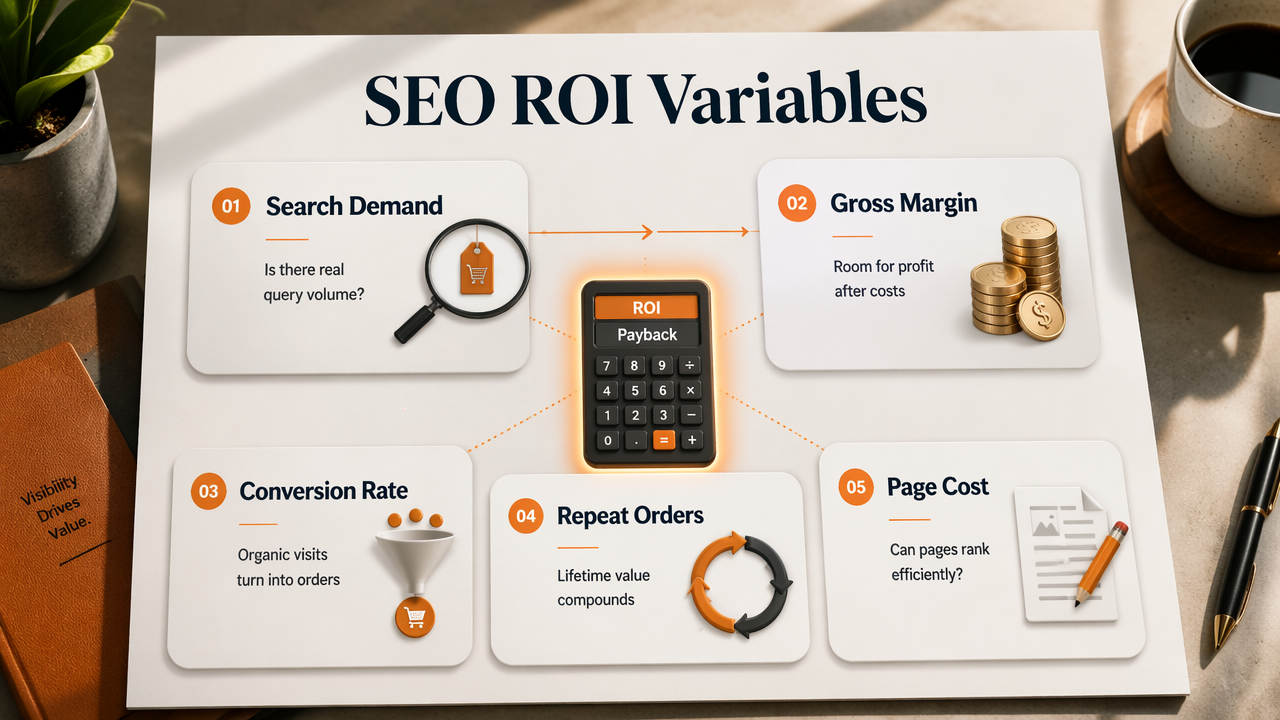
A 2024 systematic review in Human Behavior and Emerging Technologies covered big data analytics for understanding consumer behavior in digital marketing, reinforcing why ecommerce teams should connect SEO decisions to observed demand and customer behavior instead of guessing (Theodorakopoulos and Theodoropoulou, 2024).
ROI factors to model before funding SEO
| Variable | Why it matters | Practical signal |
|---|---|---|
| Search demand | No demand means limited organic upside | Keyword volume, Search Console data, marketplace queries |
| Gross margin | Profit must cover SEO cost | Margin after product, shipping, and payment fees |
| Conversion rate | Traffic needs to become orders | Category and product page conversion by channel |
| Average order value | Higher AOV gives SEO more room to pay back | Bundles, accessories, minimum free-shipping threshold |
| Repeat purchase | Lifetime value can justify slower payback | Reorder rate, subscription use, replenishment cycle |
| Product differentiation | Unique value helps pages rank and convert | Original photos, specs, reviews, expert guides |
A simple SEO payback formula for small stores
- Estimate monthly organic visits from target pages.
- Multiply visits by expected ecommerce conversion rate.
- Multiply orders by average order value.
- Multiply revenue by gross margin.
- Subtract monthly SEO spend or internal labor cost.
- Compare the result with paid ads, affiliates, and marketplace fees.
Example formula: organic visits x conversion rate x AOV x gross margin - SEO cost = estimated monthly profit.
This model avoids the common mistake of calling all organic revenue "free." SEO has costs, even when clicks are not billed.
How does SEO compare with paid ads for ecommerce?
SEO and paid ads solve different ecommerce problems: paid ads buy faster visibility, while SEO builds durable search entry points that can keep producing traffic after the original work is done. The best budget choice depends on urgency, cash flow, margins, and how much demand already exists.
Paid search often fits new promotions, seasonal inventory, and products that need rapid testing. Organic search fits evergreen categories, buying guides, comparison pages, and product lines that will stay in stock long enough for rankings to mature.
Channel tradeoffs for ecommerce growth
| Channel | Best use | Main strength | Main limit |
|---|---|---|---|
| SEO | Evergreen demand, category growth, product education | Compounding visibility over time | Slower feedback loop |
| Paid search | High-intent keywords and launch testing | Immediate traffic control | Cost stops when spend stops |
| Paid social | Demand creation and visual products | Fast creative testing | Lower intent than search |
| Marketplaces | Existing buyer demand | Built-in trust and checkout | Fees, competition, limited brand control |
| Affiliates | Partner-led promotion | Pay-for-performance potential | Quality varies by partner |
Budget split guidance for 2026
A practical early-stage split keeps paid acquisition active while SEO assets mature. Paid ads reveal which products, angles, and landing pages convert. SEO then turns proven demand into durable category pages, comparison pages, and guides.
For Shopify stores, the Shopify token setup guide can support the operational side of connecting store data and publishing workflows. Teams using other systems can review available Earlyseo integrations before planning implementation.
Decision rule: paid ads are better for speed; SEO is better for reducing long-term dependence on rented traffic when product demand is stable.
What should an ecommerce SEO plan include in 2026?
A 2026 ecommerce SEO plan should include technical crawlability, category-page optimization, product-page uniqueness, content for purchase research, structured data, internal links, and AI-answer readiness. Search is no longer only a list of blue links, so pages need clear entities, clean structure, and helpful answers.
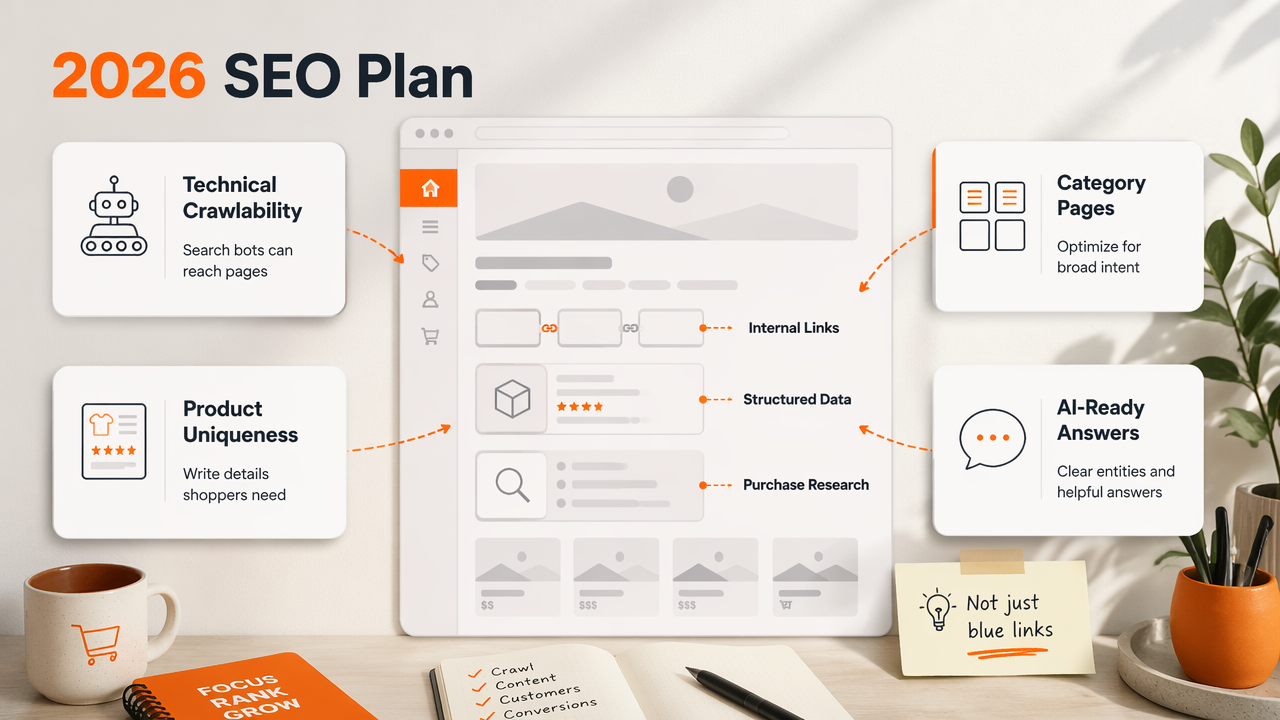
Magento remains a major ecommerce platform; Wikipedia describes Magento as an open-source ecommerce platform written in PHP, with source code under the Open Software License and Adobe's 2018 acquisition valued at $1.68 billion (Magento overview). Platform choice matters less than whether the store can publish clean, fast, indexable pages.
Core ecommerce SEO workstreams
- Technical SEO: fix crawl traps, duplicate URLs, faceted navigation, canonicals, sitemap quality, and page speed.
- Category SEO: build collection pages around how shoppers search, not just internal merchandising labels.
- Product SEO: add original descriptions, specs, FAQs, reviews, media, and compatibility details.
- Content SEO: publish buying guides, comparisons, care guides, sizing help, and "best for" pages tied to products.
- Entity SEO: use structured data, clear brand names, model numbers, materials, sizes, and attributes.
- Internal linking: connect guides, categories, and product pages so authority flows toward revenue pages.
How Earlyseo handles ecommerce visibility
The Earlyseo platform helps ecommerce teams structure search work around pages, integrations, and answer-ready content instead of scattered keyword lists. For stores that publish through content systems, the Earlyseo WordPress integration can support editorial workflows, while ecommerce teams can use earlyseo.com as a central reference point for search visibility setup.
AI search also changes how stores present information. Clear definitions, comparison tables, product attributes, and concise answers make pages easier for large language models and search features to parse. Earlyseo's LLMs.txt resource is relevant for teams thinking about how AI systems discover and interpret site content.
FAQ: ecommerce SEO value questions
Ecommerce SEO is worth evaluating through profit, time horizon, and operational readiness rather than traffic alone. The following questions cover the objections that usually decide whether organic search deserves budget now or later.
How long does ecommerce SEO take to show results?
Ecommerce SEO usually needs several months because search engines must crawl changes, evaluate page quality, and compare the site against established competitors. Faster gains can come from fixing indexation problems or optimizing existing pages that already get impressions. New content and new categories usually take longer than technical cleanup.
Can a small store compete with Amazon and large retailers?
A small store can compete when it targets specific categories, long-tail product needs, expert guidance, local relevance, or stronger product detail than large retailers provide. Competing for broad head terms is harder. Niche collection pages, comparison guides, original photos, and deep FAQs often give smaller stores a more realistic path.
Is SEO still useful if paid ads are profitable?
SEO can still be useful when paid ads work because it diversifies acquisition and can reduce dependence on auction prices. Paid campaigns can identify converting products and phrases. Organic pages can then capture similar demand over time through categories, guides, and product pages that remain useful after campaign tests end.
What makes ecommerce SEO fail?
Ecommerce SEO often fails when stores publish copied manufacturer descriptions, ignore technical duplication, target keywords with no buying intent, or measure success only by rankings. Weak margins also create problems because profitable traffic matters more than traffic volume. A focused plan should tie pages to demand, conversion, and contribution margin.
Conclusion
So, is seo worth it for ecommerce in 2026? Yes, when the store has searchable demand, enough margin to fund patient growth, and pages that deserve to rank. No, or not yet, when the business needs immediate validation, sells a short-lived product, or lacks the operational capacity to improve product and category pages.
The next step is simple: pick 10 revenue pages, model their search demand and margin potential, then choose one 90-day sprint covering technical fixes, category upgrades, and one content cluster. For guided setup, visit earlyseo.com and map the first sprint before expanding the program.